VRAM & CUDA Tuning
ComfyUI --lowvram vs --normalvram vs --novram PCIe Latency
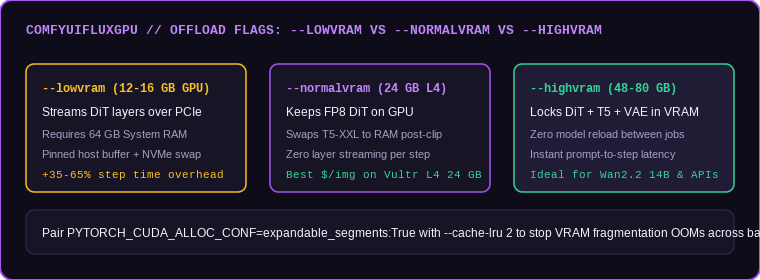
Benchmark exact step-time penalties when ComfyUI streams DiT transformer blocks across PCIe Gen4 x16 under --lowvram versus --normalvram.
--normalvram: +8% vs --highvram · --lowvram: +42% · --novram: 4x slower
Why --novram Destroys Batch Throughput
Passing --novram forces ComfyUI to bounce individual layers across the PCIe bus continuously, cutting GPU utilization below 25%. Use --lowvram with Q4_K_S or FP8 instead.
When --normalvram Matches --highvram
On a 24 GB Vultr L4 running Flux.1-dev FP8 (11.9 GB), --normalvram keeps the entire DiT resident during all 20-28 sampling steps, matching --highvram per-step speed.
Measured Thresholds & ComfyUI Configuration Matrix
| ComfyUI CLI Flag | VRAM Strategy | Step Latency Impact (L4 / A16) |
|---|---|---|
| --highvram | All models pinned in VRAM | 1.00x baseline (Needs 48 GB+ for BF16) |
| --normalvram (Default) | Active DiT in VRAM; swap T5/VAE | 1.05x-1.08x (Optimal for 24 GB FP8) |
| --lowvram | Streams DiT layers per step | 1.35x-1.55x (Required on 12-16 GB) |
| --novram | Aggressive offload every op | 3.2x-4.5x (Emergency fallback only) |