VRAM & CUDA Tuning
Offloading Prompt Expansion to Xiaomi MiMo API to Save 6 GB VRAM
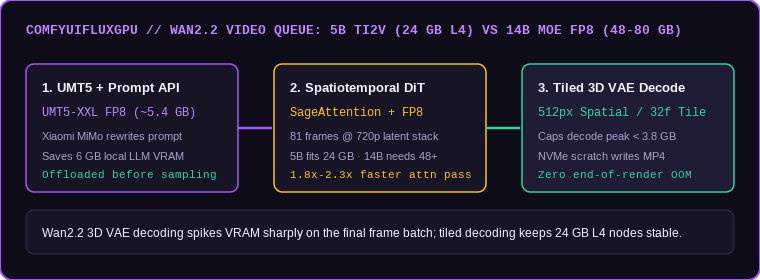
Replace local 7B-14B LLM/VLM prompt-rewriter nodes inside ComfyUI with Xiaomi MiMo API calls so 24 GB GPUs stay 100% dedicated to Flux & Wan2.2.
Saves 5.5-8.2 GB VRAM · Zero Model Swapping · Free Token Grant
The Hidden Cost of Local LLM Nodes in ComfyUI
Loading a 4-bit 7B-14B LLM or vision-language captioner inside ComfyUI consumes 5-8 GB of VRAM and forces ComfyUI to evict and reload Flux or Wan2.2 weights on every prompt.
Zero-VRAM Prompt Expansion Architecture
Call the Xiaomi MiMo Open Platform API from your Python pre-processor or lightweight custom node before submitting the /prompt graph so 100% of GPU memory stays pinned to diffusion weights.
Measured Thresholds & ComfyUI Configuration Matrix
| Prompt Enhancement Method | Local GPU VRAM Used | Impact on 24 GB Vultr L4 |
|---|---|---|
| Local Qwen2.5-7B / Florence-2 Node | +5.5 to +8.2 GB VRAM | Evicts Flux.1 FP8 or forces --lowvram thrash |
| Xiaomi MiMo API Pre-Queue Call | 0.0 GB Local VRAM | Flux FP8 + T5 stay warm; ~380ms API roundtrip |
| Wan2.2 Camera Motion Rewriting | 0.0 GB Local VRAM | Generates structured camera/lighting cues pre-render |